We did make it out of the Pole, and are now safely at McMurdo.
It was an amazing flight. It was sunny most of the way and more importantly, while we were flying over the mountains. They had equipped the plane with doors for paratroopers which meant that the windows were huge! I saw huge mountains, some without snow cover on top, glaciers, snow fields, and crevasses. It was beautiful.
It's strange to be here: it seems like there are so many people, people I've never seen before. At the South Pole, you run into the same people over and over. And now we have to lock doors and carry keys around! And there are rocks and dirt. Air feels moist and there is so much oxygen! I didn't realize I was missing it.
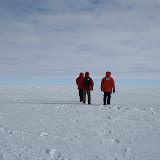
Tomorrow, we fly back to Christchurch. We have "bag drag" at 8 PM tonight which means we have to show up, have our check-in luggages weighed, and then ourselves weighed with all our extreme cold weather gear and our carry-on baggage. It's strange to be wearing the red coat above freezing temperatures.
Wednesday, January 27, 2010


Leaving South Pole?
I am scheduled to fly out with about 12 other IceCubers in a couple of
hours. The weather is not that great: we have poor visibility and
there is 12 knots of wind. The airplane did leave McMurdo so let's
hope for the best!
hours. The weather is not that great: we have poor visibility and
there is 12 knots of wind. The airplane did leave McMurdo so let's
hope for the best!
People at the South Pole: Tilo

The brain of IceCube

plugged into computers. Each DOM has it's own mainboard and an IP
address, and all 60 DOMs from "in-ice" and 4 from IceTop are plugged
into a single "hub". Each string has it's own hub, and we have now 79
strings out of the 86 projected upon completion next year. Each hub
is mounted on an electronics rack. It's a lot of hubs and cables, and
it's not trivial keeping all of them running all at the same time.
The white coats we are wearing prevent static discharge. It is
extremely dry here at the South Pole and at night with the windows
blocked by cardboard, you can see sparks from static when you shift
around under the sheets. A big shock can kill the cards in the hubs
and the coats are supposed to help with the static.
Photo by Dana
Tuesday, January 26, 2010
People at the South Pole: Jim and Forest

production of all the DOMs up north, and keeps track of all the
scientific cargo (DOMs, cables, etc.) being shipped around. On the
ice, he makes sure that the DOMs get tested go where they need to go,
and he coordinates the drilling activities with the scientists. He
also makes sure that everyone is busy, and when scientists come down
here, they know what to do.
Forest is a driller. He also takes amazing photos and when he's not
on the ice, he travels around the world as a photo journalist. Many
of the postcards of the South Pole are his work, he made a great short
film for SPIFF 2010. You can find samples of his work here.
People at South Pole: Dennis

Dennis, after having spent the whole summer season here, is headed
back home. Dennis is IceCube's driller lead. He keeps everyone in
line, including us physicists. He is full of great ideas and is
constantly improving the drilling system. Under him, the drill
consumes 50% less fuel than what was designed, a no small feat.
People at South Pole: Hutch and Gary

Hutch keeps track of where everyone and everything needs to be, and
Gary moves everything to where they are supposed to be. When some
unbelievably heavy equipment needs to move, Gary makes it happen.
Hutch is an avid runner and you will find him running after a full day
of work. Gary has wintered over several times, and yet he keeps
coming back.
People at South Pole: Sirin

the DOMs, make sure that all the new DOMs for IceCube are working and
communicating. She got here the first week of January and will be
staying for about a month, leaving the ice just a few days before they
stop flying airplanes to South Pole for 8 months.
SPIFF 2010
We had our South Pole International File Festival over the weekend. People at the station submitted something like ten films.
Some titles include The Big Shave (apparently it's a ritual for guys getting off the ice to take a nice long shave, by an IceCube driller), I'm at the Pole (spoof on I'm on the Boat), Ganzfeld (collection of photos from a Swedish IceCube driller showing scenes from his home town and Pole), The Clouds (time-lapse series of the clouds, also an IceCube entry, German), The Last Deployment (yes, I'm in it!), and others. I am so impressed how creative people are on this stations.
Some titles include The Big Shave (apparently it's a ritual for guys getting off the ice to take a nice long shave, by an IceCube driller), I'm at the Pole (spoof on I'm on the Boat), Ganzfeld (collection of photos from a Swedish IceCube driller showing scenes from his home town and Pole), The Clouds (time-lapse series of the clouds, also an IceCube entry, German), The Last Deployment (yes, I'm in it!), and others. I am so impressed how creative people are on this stations.
More moving

coming winter. We had to rearrange the drill heads to be stored in
the IceCube Lab, so we called up the help of a forklift. To access
the first floor of the raised lab, a snow ramp was built at the
beginning of the season. A pretty impressive operation. Here are some more photos.
Side experiment 2

IceCube holes is. Here is Jonas helping me take some water from the
drilling system as it gets pumped out from a hole. He stuck his hand
into the gushing water at 2-degrees C for 10 minutes to do this for
me. Thanks Jonas!
A little side experiment

ultra-high energy neutrinos. The task was to go out at least a few hundred meters from the station, find a spot where the surface has been undisturbed as possible (i.e. not plowed, walked, or skied on) and measure the flatness in a line along the direction of the wind.
For equipment, we had two circular pieces of plywood, a small inclinometer (a device that measures tilt, kind of like a bubble level but with numbers), pen, and paper.
So, the four of us, Kirill, Gary, Mark, and I checked out a radio from the comms center at the station, and set out on foot against the wind, away from the station in the direction where the snow is least disturbed. When we found a good spot, we inched our way back with the
wind on our back, 50 cm by 50 cm, gently placing one plywood circle on the snow, get two readings with the inclinometer, along and perpendicular to the wind, place the other plywood circle in front of the other, and repeat. It gets pretty cold kneeling on the snow and writing with only glove liners on.
When it's really cold, regular pens stop working. Gary owns a U.S. space pen developed by NASA for who-knows-how-many-million dollars so the astronauts can write under zero gravity. Kirill owns a Russian space pen: a pencil.
South Pole Telescope

photos at "more photos" link on the right). This building hosts two
telescopes, SPT on the left, and BICEP2 on the right. They are both
looking at different aspects of CMB, cosmic microwave background, an
imprint of what the Universe might have been like way at the
beginning. They are both impressive in their own right.
The South Pole Telescope measures the intensity and polarization
anisotropy of the CMB. They have a higher angular resolution than
BICEP, and they can detect galaxy clusters through the spectral
distortion imprinted on the CMB, and can set constraints on dark
energy that cause the expansion of the universe to accelerate. They
have 960 channels of bolometers and TES (transition edge sensors) as
their detectors, and use squid readout. Roughly 750 channels are
operational, and are looking at CMB at 90, 150, and 220 GHz.
BICEP is measuring the polarization at 100 GHz dn 150 GHz at angular
resolutions of 1.0 and 0.7 degrees respectively with an array of 98
polarization-sensitive bolometers (PSBs). They map a large region of
the sky near the South Celestial Pole. Its design is optimized to
provide exquisite sensitivity to CMB polarization on medium to large
angular scales, allowing it to directly probe for the gravitational
wave signature of inflation.
SPT uses pulse tubes to cool their detector so there is no need to
keep a stock of liquid helium. The detector is kept around 250 milli-
Kelvin - now that's really cold! I have never seen so much and such a
long liquid-helium transfer line in my life. Dana and Daniel, the two
winter-overs opened the roof of the building and showed the telescope
move: very smooth and surprisingly fast.
Because they are looking at radio frequencies, these telescopes are
operational even when the sun is up.
Where our energy comes from

They take energy efficiency very seriously here. They track where all the electricity goes, and occasionally, we get a station-wide announcement over the loud-speaker that we should turn off all unnecessary lights and computers.
It takes a lot of energy to produce water and we are requested to keep our showers to 2 minutes of water usage and 2 showers per week. If you do really sweaty work (drilling, cooking, etc) you can take more. I was a bit worried about this before getting here, but it's
not too bad. It is so dry here it you really don't notice it, and if you turn the water off to lather up 2 minutes is a fairly long time. It also helps that everyone is in the same boat. Still, I'm looking forward to a long bath when I'm back.
I was told they hope to replace the Jamesway summer camps with a super-energy efficient, off-the-grid camp. The South Pole Station can sleep about 150 people and during the summer, about 100 people sleep in the summer camp, in Jamesway tents. Jamesways are modified tents much like what they used during... the Korean war? They are well insulated and heated inside, but there is a big gradient in the temperature inside and very energy inefficient: you can keep your soda
cold on the floor but sleep comfortably in a bed. You have to run outside to another Jamesway to go to the bathroom. The new summer camp would be totally off the grid and the hope is to find solar panels that will work at these temperatures. With 24 hours of sunlight, it should be great! They have tried turbines (wind power) but the ones they tried didn't work at all: the wings never turned.
Where the water comes from

was bored out by a machine designed after those that are used for
mines. The machine fits exactly the size of the tunnel, and the snow
is piped out to surface from behind it. When they had to make
repairs, they cut into the snow beside it to make a little cave. The
pipes you see are for water and sewage. It is -55F in the tunnel
(near average of the summer and winter temperatures outside), so the
pipes are heated and wrapped with insulation. The tunnel currently
starts at about 15 ft below surface and is gently sloped down and ends
at 50 ft below. The South Pole Gravity Station is located off to the
side, at about 30 ft below surface.
The South Pole Station gets all its water from a well in the ice.
These wells are called "rodwell" http://www.southpolestation.com/trivia/rodwell/rodwell.html
after Raul Rodriguez after an Army engineer who originally developed
the idea. You essentially melt a big cavity in the ice 200 m below
surface and pump the water out. When the well reaches 500 m deep, it
becomes very difficult to pump the water out, so we move onto the next
hole. The dry holes are used to store waste water. Currently the
station is using water from "rodwell-2", the second hole, and are
planning to move onto rodwell-3 soon. Each hole lasts about 7 - 10
years depending on how efficiently we use the water and how well the
melting goes. Bigger bulb the longer each well lasts.
To melt the water, excess heat from the power plant is used. The
station is all about energy efficiency. See the next blog for where
we get our energy.
Along the tunnel, there are several "shrines" set up by past winter-
overs. A pig's head donated by the Russian station (I think I heard
that right...), helmet signed by the miners who dug out the tunnel, a
mummified fish, and so on.
I will post more photos from the well at "more photos" http://picasaweb.google.com/RainSnow3Ice
.
First mother and son pair at South Pole

to have a mother and son pair at the Pole at the same time (I'm not
sure if there is even a mother and son combo at different times).
Richard came here as a driller for the entire summer and has been here
since beginning of December. Terri came here after a few days after I
did (I saw her in Christchurch), and she plays a crucial role as an
HR: a major part of the reason that our time on the ice has been
successful can be attributed to the fact that IceCube has a driller
retention rate of 90% from season to season. We are able to attract
the best and retain them year after year. It's not trivial drilling
2.5 km holes into the ice at Antarctica at -40 degrees (at this
temperature it doesn't matter if C or F). Everyone remembers the
mistakes and improvements from the past, and ramp up time after the
long winter is very fast. We started out with only 1 string the first
season, then 8 during second, 14 during third, 18 during fourth, 19
fifth, and 20 this year. By now the drilling goes fast: if you aren't
paying attention, you could miss a few.
Congratulations, Terri and Richard!
Thursday, January 21, 2010
Last String!


It takes about 24 hours for the hot water drill to drill the hole, a couple of hours to switch from drilling to string deployment, then three to five hours to deploy the string depending on the team and whether there are special devices being deployed as well. The hole is drilled by a whole different set of crew of 30 working on three 8-hour shifts per day, drilling at the rate of two to three holes per week. The deployment works on two shifts since it usually takes maximum of five hours per hole.
During string deployment, there is one person operating the two motorized winches (one for the main cable and another to help keep the DOM in place while it gets installed) (the woman in the yellow helmet), two people standing next to the string to prep the string and install upper connection to the DOM (two guys in sunglasses), one person hooking up the lower connector (the guy behind me with black neck warmer), one person prepping the DOM (fourth from left), one person with a clip board and a check list making sure all connections are made, measuring the distance between each DOM, and writing down the cable markings (the guy in blue fleece), and one person feeding the signal cables and taking a photo of each DOM as a record of how they were connected and which one was deployed (this was my job). You see two more people in the photo: the woman in the green helmet in the back helped prep the DOMs, and the blue helmet to the right of the DOM oversaw the whole thing, making sure that the main cable was spooling out correctly and helping out with whichever job may be falling behind.
Once it starts flowing, it's like playing in a string quartet: everyone knows their job and everything flows very smoothly. It was extremely satisfying to be working in a team of very competent, hard-working (and fun of course) people, and at the end, there is a very tangible result.
Since this was the last string, we had many visitors during deployment, from IceCube drillers and scientists to past members of the collaboration who now works on other projects at the Pole, and DV's (distinguished visitors) from the NSF and DOE who just happened to be visiting the South Pole for the day. We all got to sign the last DOM, and it was lowered into the hole by 6 PM. From there, the cable had to be lowered another 1500 m, put on an R&D device at -50 m, the cable tied off, and were really done by 9 PM. This morning, we turned on the DOMs for a quick look, and everything seem connected. In all, I helped deploy three strings this season.
Now it's time to clean up, and my job is to start the initial calibration of the DOMs, make some configuration files for the data acquisition system, and hand them off to the collaboration.
The drillers will be packing everything up for the winter and start leaving the Pole in the next one to two weeks. I will be leaving with the first of the crew. After that, we wait for the DOMs to freeze in and it's up to us scientists to turn on the detector and discover something.
How cold is it?

Yesterday's maximum was -5.5F (-20.8C), minimun was -16.1F (-26.7C)
whereas the average for this time of the year is -20.4F (-29.1C)
(there is no average max and min because the sun is up 24 hours a
day). Still, if you leave a bottle of water outside, it will freeze
pretty quickly. This is my water bottle that I left in my backpack in
the back of the snow-mobile for about 30 minutes.
Tuesday, January 19, 2010
Monday, January 18, 2010

People at South Pole: Gary and Mark

didn't forget anyone) all came out to greet the plane and me. They
are all people I work with back in Madison and it was so nice to see
familiar faces after days of traveling. I only managed to get photos
of Gary and Mark then so I will just talk about them. I *had* to take
a photo of Gary in his mask!
Both are research scientists like me, but they have been down to the
Pole many times. Gary has wintered over at pole some ten years ago.
Mark is known for being at the right place at the right time, like
flying into Hawaii to go diving and seeing a mother whale and baby
whale dancing in the water (his dive leader who dives nearly every day
there has never seen anything like it) or being swarmed by penguins at
McMurdo.
People at South Pole: Denise

couple of weeks. She has been at McMurdo since last fall, but when
one of the physicians at South Pole had to go home for a couple of
weeks for family emergency before wintering over, Denise was asked to
be the replacement. Denise is from the U.S., but has been spending
the last few years traveling up and down the West Coast of New Zealand
as *the* doctor there. She had been training to run the marathon at
McMurdo last Saturday (this would have been her first marathon!) but
hopped on the opportunity to come to the South Pole instead. She was
already talking about going out skiing for a few miles out.
Incidentally, an IceCuber won the McMurdo marathon. He has been at
South Pole since November or December and won the around-the-world
race over new years where they set up a few-mile long course around
the South Pole. Every year, the winner of this race gets a trip up to
McMurdo to participate in the marathon. Aside from being already in
great shape to begin with, being acclimatized at 10,000 ft must be a
great advantage!
More Penguins!

emailed me her photos of the emperor penguins. These are the same
penguins I saw when I was at McMurdo, and they have now been standing
in the same place for more than a week. Does anyone know why?
People at South Pole: Dana

connection to Christchurch. We ended up being routed through Auckland
then to Christchurch, arriving 8 hours later than scheduled, for a
total travel time of 43 hours. Dana is a rocket scientist by day and
every other year, has been spending the "nights" wintering over at
South Pole where 30 to 50 people spend eight months with no flights
coming in and out. This will be his fifth time wintering over! He
was extremely helpful and aside from being just a great person, it was
great to have a travel companion who really knows his way around. He
showed me where to go, when to show up, told me what to expect and not
expect, and where the best Thai restaurant in Christchurch is. Thanks
Dana!
People at South Pole: Brian

his PhD from UW in physics, and was *the* electronics expert in the
department when I was there. He has since moved onto being the *the*
electronics expert at other departments at UW, and has been coming to
South Pole for many years. I had no idea he would be here, and just
ran into him in the hallway on my way back from dinner. What a small
world!
People at South Pole: Jason

Harry Reid, in health and education. He told me what it was like the
past few months pulling together the health care package. It's still
a crazy busy time for him, but was able to make this day trip to the
South Pole. His background is in education and public policy. He
taught/was a principle at middle and elementary schools before going
into public policy and coming to D.C.
People at South Pole: DV's

South Pole who were what we call DV's, distinguished visitors. This
is Daniel Ginsberg and Chan Lieu, just as they got off the plane at
South Pole. They are on a very tight schedule: they are only making a
day trip to the South Pole, so in a few hours, they already flew
back. In a few hours, they have to assess and see whatever it is that
their job brings down them for. Hilary Clinton was in New Zealand
right around the time we flew to Antarctica and one of the DVs told me
they were trying to see if they could arrange her to come at least to
McMurdo. In the end, the uncertainty that is inherent Antarctic
travel made it impossible to fit the trip into her busy schedule.
The U.S. Air Force Reserve handles the logistics like flights in and
out of Antarctica. From what I understood, Daniel Ginsberg is in
charge of the allocation of manpower for the reserve, and he is the
one making sure that support for science and other responsibilities
are allocated and handled appropriately.
Chan Lieu is the staff director for the U.S. Senate science and
transportation subcommittee on science and space. He directs people
who collects data for the Senate and gives advice on how they should
spend money for science and space programs (I think I got that
right...). He has an IT background.
Wow!
People at South Pole

(sorry I don't know who he is). I wrote about Charlie in an earlier
blog, his first wintering in Antarctica being in 1957 - 1959 during
which he and his fellow travelers discovered mountains. He is back at
South Pole to take a look at the IceCube drill, to see if it's
something he would like to use for some new expedition that he is
concocting.
People at South Pole: Martin

everything at the Station is running, from water, heating (very
important), you name it. I met him at bag drag at McMurdo, where we
have to bring our bags to a certain location and have all our check-in
luggage weighed, then ourselves and carry-on weighed for the flight to
South Pole. He was also on the same flight the next day. This is his
second time going down: he was out earlier this season, went home to
Denver for the holidays. Then he got a call requesting that he come
back because the person who took over his job for the second half of
the season got sick and had to go home. So here he is, back at South
Pole again. This must be some sort of record...
People at South Pole: Scott

historic Scott hut where the British explorer staged the Discovery
expedition in 1902. Scott and Amundsen were the first to reach the
South Pole in 1912, Amundsen on December 14 and Scott on January 17.
The hut still stands, and once in a while they have tours where you
can walk in and see how the early polar explorers lived. There was no
tour when I was there, but I could peak in the windows to see some
boxed biscuits and canned meats. There is also the 100-year old
mummified seal near the entrance, you might barely be able to see in
this photo: it's the lump at the left of the building.
People at Antarctica: a geologist

of Wyoming. He will be flying on a helicopter from McMurdo to the Dry
Valleys to study gullies. He wants to see if there are analogy
between the gullies there and those on Mars. He will be staying at
camp set up by the NSF (National Science Foundation who also runs
McMurdo and South Pole Station) which apparently has also satellite
connections. He will scan the gullies using a really fancy laser
setup. The laser scans the gully over a distance of over half-a-
mile. The reflected light from the dirt, snow, and several mirrors is
recorded on a sensor, and from this, he can map out the floor of
entire valleys. How cool is that!
He has also flown on a zero-gravity airplane, better known as vomit
comet. These airplanes will go up and down on arcs, and when they
reach the top of the arc, you get some 10 seconds of weightlessness.
He was studying how sediments, or mud settles or doesn't settle with
no gravity. They carry scientific experiments, and there are
competitions for high school and college students where you can submit
experiments to do on one of these.
People at South Pole: Allison

spending a couple of weeks at McMurdo packing up an experiment so
technically she is not at the pole but I thought what she does is
interesting, I though I would tell you about her. Her main project is
to study aurora. She normally spends her time near the other pole,
the North Pole. She goes up to Alaska in the winter, shoots up
sounding rockets with magnetic field sensors and studies the data that
gets transmitted back while the sensor is up in the air. The whole
experiment is essentially destroyed when the sensor comes back to
ground. She is not normally working on this particular experiment
here but she volunteered to help out.
Saturday, January 16, 2010
Day 1

I felt much better today, and went out to help deploy an IceCube string. My job was to help feed the signal cables down, and take a photo of each Digital Optical Module (DOM) so that we have a record of which one went where and where the cables are. The IceCube drill site is about a mile away from the Station where we are staying. We took a shuttle bus out, and came back on a sled pulled behind a snowmobile. Fun!
There was also a group photo op for decommissioning of the old South Pole Dome. That's the dome that's in all the photos. The Dome was the old station, it was almost completely buried in the snow that is accumulating every year. They have almost completely taken it apart,
with just a few panels left. We took a photo in front of it.
As if that's not enough, BBC's Sir David Attenborough is filming BBC's frozen planet. They were flying a twin otter to try to get some nice shots, and flew over the dome photo shoot. Afterwards, I saw him in the Station so I asked him how it went. He said he was glad that the weather didn't cooperate and they weren't able to get what they wanted. This meant that he *had* to stay overnight at the Station and he was excited about that. What a day!
I will need a better satellite connection to upload photos: hopefully I can do that in the next couple of days. For now, here I am in front of the ceremonial geographic South Pole. The real geographic south pole is a few meters away, and shifts every year. There is another marker there, with markers designed by the winterovers from the previous year.
Friday, January 15, 2010
South Pole!
I tried posting earlier, but it hasn't appeared yet. I'm still trying to work out the kinks in connectivity, so you may see another post saying that I am here.
We left McMurdo with no more delays, after seeing a few emperor penguins. Those are the penguins that is in March of Penguins, Happy Feet, and so on. They were just huddling by the road between the McMurdo base and the airplane runway. Photos to come soon.
The flight was amazing. We flew over the Transantarctic Mountains, then into NPX (the code at the runway at the South Pole!) for an extra smooth landing. I flew on a ski-equiped LC-130 with a few military personnel, a couple of winter-overs, the assistant station doctor, operations manager and eight or so DV's (distinguished visitors). I will write more on them later as they are doing pretty interesting jobs. And last but not least, our very own Charley Bentley from the geology department at UW, who spent 1957 - 1959 at the South Pole! In those days, you took a ship. You couldn't get through the ice until late summer when the sea ice had melted enough for ice breakers to get through. This is still the case today if you travel by ship. In fact, the first ship to McMurdo will arrive in the next few days. This meant that to get a full season of scientific exploration, you got to Antarctica in late January, spend the entire winter there, spend the summer, and come back if you can that late summer, or spend another winter, then come back. Wow! By 1957, they had giant snow cats etc. so they were able to bring in heavy equipment. They discovered some mountains along the way, and so, he has a mountain named after him!
We left McMurdo with no more delays, after seeing a few emperor penguins. Those are the penguins that is in March of Penguins, Happy Feet, and so on. They were just huddling by the road between the McMurdo base and the airplane runway. Photos to come soon.
The flight was amazing. We flew over the Transantarctic Mountains, then into NPX (the code at the runway at the South Pole!) for an extra smooth landing. I flew on a ski-equiped LC-130 with a few military personnel, a couple of winter-overs, the assistant station doctor, operations manager and eight or so DV's (distinguished visitors). I will write more on them later as they are doing pretty interesting jobs. And last but not least, our very own Charley Bentley from the geology department at UW, who spent 1957 - 1959 at the South Pole! In those days, you took a ship. You couldn't get through the ice until late summer when the sea ice had melted enough for ice breakers to get through. This is still the case today if you travel by ship. In fact, the first ship to McMurdo will arrive in the next few days. This meant that to get a full season of scientific exploration, you got to Antarctica in late January, spend the entire winter there, spend the summer, and come back if you can that late summer, or spend another winter, then come back. Wow! By 1957, they had giant snow cats etc. so they were able to bring in heavy equipment. They discovered some mountains along the way, and so, he has a mountain named after him!
Thursday, January 14, 2010
Wednesday, January 13, 2010
McMurdo
I have reached McMurdo. We flew on a military plane along with cargo and a few distinguished visitors from Washington. Saw a few penguins already, and a couple of seals from a distance. More on this in the next few days!
Tuesday, January 12, 2010
Wintering over
I had dinner last night with the winter-over for the South Pole Telescope. This would have been his last dinner at a restaurant for the next year if our flight hadn't been cancelled this morning. This is his fifth time wintering over. He will be there from now until at least mid-October 2010, most likely into November. That's almost an entire year.
I asked him why he keeps coming back: he told me about the beautiful night skies, often with spectacular aurora, the community of people formed around those who have done this for many years, the simplicity of it all, focusing on your work, surviving. As a drummer, one of his favorite years was when he wintered over with an engineer who used to be a professional guitarist. They had some really great music going and he learned a lot about music.
This brings us to the question: would you ever want to winter over? Here are some statistics.
I asked him why he keeps coming back: he told me about the beautiful night skies, often with spectacular aurora, the community of people formed around those who have done this for many years, the simplicity of it all, focusing on your work, surviving. As a drummer, one of his favorite years was when he wintered over with an engineer who used to be a professional guitarist. They had some really great music going and he learned a lot about music.
This brings us to the question: would you ever want to winter over? Here are some statistics.
24 hr delay
It's official. We are delayed by 24 hours flying out of Christchurch,
probably due to weather. We will try again tomorrow.
probably due to weather. We will try again tomorrow.
4 hour delay
We just heard that our flight to McMurdo has been delayed by 4 hours.
The B&B owner gets a call (we have no phones in our rooms), and he
goes around knocking on everyone's door (everyone who's going that
is), and the super-shuttle is again delayed. Let's hope we fly today!
The B&B owner gets a call (we have no phones in our rooms), and he
goes around knocking on everyone's door (everyone who's going that
is), and the super-shuttle is again delayed. Let's hope we fly today!
Monday, January 11, 2010
Clothing Distribution
Today I was at what is known as "CDC". No, not Center for Disease Control, but Clothing Distribution Center. This is where we get our Extreme Cold Weather gear, including the famous red parka you see in photos. It is located next to the CHC airport, next to the International Antarctic Center. It is also next to the terminal where I will be taking off from tomorrow to fly to McMurdo.
Once we go there, we got checked out by the nurse. She went over our records briefly, made sure that we had our seasonal flu vaccination, then took our temperature to make sure we're not sick (including H1N1). Then she discussed different options for altitude acclimatization (diamox, decadron, or nothing. In the past they also used to offer Ginko). Then we had some orientation speech and a video, and we were off to try out our ECW gear.
There are a couple of big carpeted room, one for men and and one for women. In it were two orange duffle bags full of gear for each of us. There were only three women today, so we had plenty of room to spread out. The point is to try out everything to make sure they all fit and are comfortable, and swap out anything that doesn't fit. Each bag is customized for us for size and the types of jobs we will be performing in Antarctica.
One of the other women is going to McMurdo to pack up some gear from an experiment and she will probably be there for 2-3 weeks. The other one is an engineer in operations. She will first go to McMurdo for a few days, then to South Pole after.
Here is what was in my bag: Big giant red parka, thin red windbreaker that looks just like the big giant red parka, snow pants (bib), pair of giant white boots (nicknamed "bunny boots") that I exchanged for big black boots which I didn't like and exchanged for blue "FDX" boots, two pairs of thick wool tube socks, two pairs of leather work gloves with some insulation, a pair of wool mittens, a pair of leather mittens, a set of long underwear, a set of fleece underwear, fleece jacket, balaclava, fleece hat, ski goggles, neck gator, another pair of fleece pants. Did I forget anything? Anyway, you can see in the photos all the stuff they packed for me. The red parka is a name tag with our names on it. I was tickled to see "Dr." in front of mine: hardly anyone ever calls physicists that.
Everyone I talked to said getting boots that fit is one of the best ways to make your life comfortable at the Pole. Hence the multiple swapping.
So, here we are. I have my gear. Now I'm all set to go.

Once we go there, we got checked out by the nurse. She went over our records briefly, made sure that we had our seasonal flu vaccination, then took our temperature to make sure we're not sick (including H1N1). Then she discussed different options for altitude acclimatization (diamox, decadron, or nothing. In the past they also used to offer Ginko). Then we had some orientation speech and a video, and we were off to try out our ECW gear.
There are a couple of big carpeted room, one for men and and one for women. In it were two orange duffle bags full of gear for each of us. There were only three women today, so we had plenty of room to spread out. The point is to try out everything to make sure they all fit and are comfortable, and swap out anything that doesn't fit. Each bag is customized for us for size and the types of jobs we will be performing in Antarctica.
One of the other women is going to McMurdo to pack up some gear from an experiment and she will probably be there for 2-3 weeks. The other one is an engineer in operations. She will first go to McMurdo for a few days, then to South Pole after.
Here is what was in my bag: Big giant red parka, thin red windbreaker that looks just like the big giant red parka, snow pants (bib), pair of giant white boots (nicknamed "bunny boots") that I exchanged for big black boots which I didn't like and exchanged for blue "FDX" boots, two pairs of thick wool tube socks, two pairs of leather work gloves with some insulation, a pair of wool mittens, a pair of leather mittens, a set of long underwear, a set of fleece underwear, fleece jacket, balaclava, fleece hat, ski goggles, neck gator, another pair of fleece pants. Did I forget anything? Anyway, you can see in the photos all the stuff they packed for me. The red parka is a name tag with our names on it. I was tickled to see "Dr." in front of mine: hardly anyone ever calls physicists that.
Everyone I talked to said getting boots that fit is one of the best ways to make your life comfortable at the Pole. Hence the multiple swapping.
So, here we are. I have my gear. Now I'm all set to go.
Sunday, January 10, 2010
Christchurch, Part 1
So, I've made it to Christchurch. I am staying at a quaint little family owned B&B. The B&B is frequented by many going to and coming from the Antarctica, and I was told this would be a great place to stay if you want friendly owners and run into lots of people going to the Pole. Last night on my way to the shower, I ran into a fellow 'Cuber Klas from Sweden. He is on his way back home from the Pole. Then at breakfast, I ran into another 'Cuber, also on her way back. This is great!
Today is a free day: Pole veterans recommended that I should take at least three nights in Christchurch to rest up and get used to the time zone. (South Pole operates on New Zealand time) It's probably a good idea considering the high chance that you may have to wait for your lost luggage etc. Klas had rented a car, and he kindly offered to take me along for a drive out west into the mountains to see lime rock formations. After some adventures along route 73, we got up into the mountains when it started getting very windy and rainy. The car was being shaken from side to side as we drove through the pass. The rain cleared long enough to take a couple of pictures, then picked up again, all in all, it was a fun drive. Thanks Klas! The drive reminded me of Arizona or Colorado, with a little bit of the Bay Area mixed in: dry mountainous landscape with wisps of tall grass and rocks, also eucalyptus trees. We saw sheep, alpaca, and ostrich farms. Oh and wineries too.
Once back in Christchurch, we saw sun peaking through the clouds again, so we had some lunch outside, and went our own ways: I went for a little walk around to orient myself in the city. It is a beautiful city. A strange mix of the Wild West and the proper British gardens.
Tomorrow I'm headed to the CDC (no, not the Center for Disease Control, but the Clothing Distribution Center) to get fitted for my ECW (Extreme Cold Weather clothing and gear). I am to report exactly at 1300 hr.
Today is a free day: Pole veterans recommended that I should take at least three nights in Christchurch to rest up and get used to the time zone. (South Pole operates on New Zealand time) It's probably a good idea considering the high chance that you may have to wait for your lost luggage etc. Klas had rented a car, and he kindly offered to take me along for a drive out west into the mountains to see lime rock formations. After some adventures along route 73, we got up into the mountains when it started getting very windy and rainy. The car was being shaken from side to side as we drove through the pass. The rain cleared long enough to take a couple of pictures, then picked up again, all in all, it was a fun drive. Thanks Klas! The drive reminded me of Arizona or Colorado, with a little bit of the Bay Area mixed in: dry mountainous landscape with wisps of tall grass and rocks, also eucalyptus trees. We saw sheep, alpaca, and ostrich farms. Oh and wineries too.
Once back in Christchurch, we saw sun peaking through the clouds again, so we had some lunch outside, and went our own ways: I went for a little walk around to orient myself in the city. It is a beautiful city. A strange mix of the Wild West and the proper British gardens.
Tomorrow I'm headed to the CDC (no, not the Center for Disease Control, but the Clothing Distribution Center) to get fitted for my ECW (Extreme Cold Weather clothing and gear). I am to report exactly at 1300 hr.
Saturday, January 9, 2010
En route
I have several travel companions with me on this trip: they are ambassadors from Y's preschool: Chipmunk, Koala, and the Story Fairy. Here they are, taking a break at the St. Louis airport.

All in all, it was a long trip. I am finally in my hotel room at Christchurch, after something like 43 hours of traveling. I missed my connection in Sydney, got rerouted through Auckland, and got in some 8 hours later than when I was scheduled to. I was lucky though: there was another snow storm coming through the midwest and I made it out of Madison AND St. Louis. Then I met another person going to the Pole in Sydney. It was great to have someone to travel with: no more lugging luggage into the bathroom :) He is a winter-over for the South Pole Telescope, and this will be his fifth time wintering over. Wow! Here is his website. He will be staying at South Pole at least until November. Unfortunately, he was not quite as lucky as me: his checked-in luggage didn't make it with us so he will have to wait a day or so to get his.
All in all, it was a long trip. I am finally in my hotel room at Christchurch, after something like 43 hours of traveling. I missed my connection in Sydney, got rerouted through Auckland, and got in some 8 hours later than when I was scheduled to. I was lucky though: there was another snow storm coming through the midwest and I made it out of Madison AND St. Louis. Then I met another person going to the Pole in Sydney. It was great to have someone to travel with: no more lugging luggage into the bathroom :) He is a winter-over for the South Pole Telescope, and this will be his fifth time wintering over. Wow! Here is his website. He will be staying at South Pole at least until November. Unfortunately, he was not quite as lucky as me: his checked-in luggage didn't make it with us so he will have to wait a day or so to get his.
Monday, January 4, 2010
A few more days


Happy new year, everyone!
It's almost time to go to the South Pole. I have been scheduled to go for many months and have had my plane ticket ready for a few months, and finally, I will be flying out in a few days. Now that the holiday fun and craziness is over, it's finally sinking in.
You know the saying about how you get to Carnegie Hall (practice, practice, practice...)? Well, how do you get to the South Pole? There are many ways to get there: you can mount an expedition (see Shackleton, Amundsen, or Scott), ski, or run a marathon (O.K. not strictly the Pole, but close enough). I opted for many many years of education + research, and airplanes. There are many other ways to get there (becoming an U.S. Senator, for example), but I'm going as a scientist with IceCube to help build a neutrino telescope (more on this later, I'm sure). There are many accounts of what it's like to get to and to be at South Pole, but I wanted to share my experience, so, bear with me...
So, how do you really get there? I will be flying through Los Angeles, through Sydney, Australia, then spend a few nights at Christchurch in New Zealand. In New Zealand, I will pick up my "Extreme Cold Weather" clothing, then on to McMurdo Station at the edge or Antarctica, spend one night there, then onto South Pole proper. The geographic pole to be more precise. I will spend about 2 and a half weeks there, then make the trip backwards home some time in February.
I will be in good hands as there will be many friends and colleagues already there, and it's comforting to know that all along the way, English will be the official language. In that regard, I've worked at far more remote places than this. With a husband who speaks a mix of German/British/Seattle and a 2-year daughter who speaks with a pure Wisconsinite accent, I can't even complain about the Kiwi accent in New Zealand :).
Anyway, I hope to share some of my adventures with you during the next few weeks.
In case you're curious for more, I have collected some links:

Subscribe to:
Posts (Atom)